Disney trivia fundraisers consistently outperform silent auctions, bake sales, and golf tournaments on net dollars per volunteer hour. A well-run event for 100 attendees produces $4,000 to $8,000 in net proceeds, runs in a single evening, and requires fewer than 50 volunteer hours from start to finish. The reason is structural: parents and donors actually want to come.
Below is the playbook. Built for a PTA, parochial school, or small nonprofit running its first Disney trivia event, with realistic numbers, a sponsorship template, and the specific format choices that make the night convert from "people had fun" to "we cleared rent for a month."
Why Disney works for fundraisers specifically
Three reasons Disney outperforms generic trivia for fundraisers:
The audience self-selects. Parents of school-age kids are the prime Disney trivia demographic. Aunts, uncles, and grandparents within five years of a Pixar release are a close second. The ticket buyer and the audience are the same person, which makes the marketing trivial.
The format is family-friendly. Schools and most nonprofits cannot run anything that feels like a bar event. Disney trivia is content-pure — no R-rated questions, no political content, no awkward moments. You can have an 8-year-old and an 80-year-old at the same table.
The brand carries itself. Putting "Disney Trivia Night" on the flyer sells more tickets than "Trivia Night for the Cause." A 3rd-grade parent in suburban Denver organizing a school auction tested generic trivia versus Disney-themed trivia year over year and saw 2.4x ticket sales for the Disney version with no other change to the marketing.
Ticket pricing for fundraisers: the structure that maximizes net
Fundraiser ticket pricing has different math than commercial trivia. The goal is not headcount — it is net per attendee. Tiered pricing converts better than flat pricing because it lets price-sensitive families participate while pulling premium dollars from donors who want to give more.
The structure that works for most school and small-charity fundraisers:
- Individual ticket: $25. The single-attendee price. Includes entry plus one drink ticket if alcohol is served.
- Team table of 6: $135 ($22.50/head). Encourages friend groups and families. Slight discount as a volume incentive.
- Sponsor team table: $250. Includes 6 tickets plus name on table tent and one shoutout from the host. Often pre-sold to local businesses.
- VIP table for 8: $400. 8 tickets, premium seating up front, extra raffle entries, name on the program. Pre-sold to top donors.
A 100-person event with this mix — 40 individuals, 6 team tables, 4 sponsor tables, 2 VIP tables — produces about $3,810 in ticket revenue before any sponsor donations or auction. That is the floor.
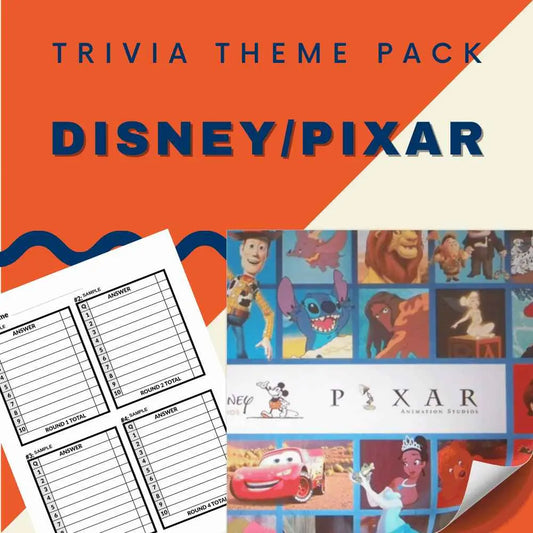
Disney Trivia Night Theme Pack
40+ Disney questions across 4 rounds, picture round, tiebreaker, host script, and ready-to-project PowerPoint. Designed for events of any size — print and project, no software setup required.
Sponsorship asks: where the real money comes from
Ticket revenue is the floor. Sponsorships are how the event nets $5,000 to $8,000. The ask is easier than most volunteer organizers expect, because local businesses get tangible visibility in front of a known audience.
The four sponsor tiers that work for a 100-person Disney trivia fundraiser:
- Title sponsor — $1,500. Logo on every flyer, social post, and program. Five-minute pre-event speaking slot. One free VIP table. Typically a local realtor, dental practice, or CPA firm.
- Round sponsor — $400. Each of the 4 rounds is "presented by" a local business. Logo on the slide for that round, host shoutout, name in program.
- Prize sponsor — $200. Donates a prize valued at $100+ in exchange for a host shoutout when the prize is awarded.
- Table sponsor — $100. Logo on table tent. Often a small local business that wants visibility but cannot afford bigger.
One title, four round, six prize, and ten table sponsors yields $5,500 in sponsorship dollars on a 100-person event — on top of the $3,800 in ticket revenue. Most local PTAs and small charities can fill this slate by tapping the parent network. School-affiliated families running businesses are typically eager to sponsor an event their own kid will attend.
Prize pools that drive ticket sales
Prizes for fundraisers serve a different role than prizes at commercial trivia. Here, prizes are marketing — they convince people to buy tickets. The strongest fundraiser prize stack:
- Grand prize: Disney World 2-park family pass for 4 (donated by a travel agent sponsor) or a $500 cash equivalent. Drives ticket sales when announced 4 weeks before the event.
- Round-by-round prizes: Themed gift baskets, $50 local restaurant gift cards, family experiences (mini golf for 4, ice cream party for 6).
- Picture round prize: Disney art print framed for the home, or a $100 craft store gift card.
- Best team name: Crowd-vote at halftime. Prize: small Disney plush set for the kids on the team.
- Raffle (optional add-on): $5 per ticket or $20 for an arm's length. Prizes drawn at the night's end. Adds $400-$1,000 in revenue for a 100-person event.
A small parochial school in suburban Chicago ran a Disney trivia fundraiser as its annual gala replacement and sourced the grand prize from a parent travel agent who comped a $1,200 Disney World pass package. The gala had been netting roughly $3,200 a year. The Disney trivia version netted $6,800 the first year and $9,400 the second year — with the same volunteer team running it.
Run-of-show: the 90-minute fundraiser format
Fundraisers run slightly longer than corporate events because the room expects a real evening, but shorter than a bar trivia night because families with kids leave by 9pm. The cadence:
- 0:00-0:30: Doors open, ticket scanning, drink/dessert service, mingling. Sponsor banners visible.
- 0:30-0:35: Host welcome, sponsor thank-you, format explanation.
- 0:35-0:48: Round 1 (Disney movies and characters). Easy starter round.
- 0:48-1:00: Round 2 (Disney music and quotes). Slightly harder; tests film recall.
- 1:00-1:10: Halftime — team-name vote, dessert, raffle ticket sales pitch from emcee.
- 1:10-1:25: Round 3 (Picture round). Iconic scenes, characters, settings.
- 1:25-1:40: Round 4 (Parks, history, deep cuts). Hardest round; biggest scoring spread.
- 1:40-1:50: Final scoring, raffle drawing, prize ceremony, closing thank-yous.
Reality check: the raffle is the second-highest revenue line of the night. Build the pitch into the halftime block, not as an afterthought. A 30-second emcee speech on what the funds support typically doubles raffle ticket sales.
Volunteer roles for a 100-person event
The right volunteer count is six to eight. Fewer means a frantic night; more means people stand around and feel underused.
- Event lead (1): Owns the run-of-show, talks to host, troubleshoots.
- Host (1): Reads the questions, manages timing, runs the prize ceremony. Hire if no one is comfortable on a microphone for 90 minutes.
- Door / ticket scan (2): Check tickets, hand out answer sheets and pens.
- Scoring team (2): Collect answer sheets, score, hand standings to host.
- Raffle / prizes (1): Sell raffle tickets, manage prize table, hand prizes to winners.
- Sponsor liaison (1, optional): Greets sponsors, ensures their banners and table tents are visible, manages sponsor speaking slot.
Marketing timeline: 6 weeks to sold-out
Disney trivia fundraisers reliably sell out at 100-person scale in 6 weeks of marketing. The timeline:
- Weeks 6-5 out: Save-the-date email blast to the school or organization list. Sponsorship outreach to local businesses.
- Weeks 4-3 out: Tickets go on sale. Social posts 2x per week. Confirm sponsors and post their logos.
- Weeks 2-1 out: Reminder emails. Promote the grand prize. Sell the last 25 tickets.
- Week of: Last-call email and social post 3 days before. Day-of reminder text or email.
The single highest-ROI promotion is the school newsletter (or church bulletin, or community group email list). Whatever your organization's recurring direct-to-supporters communication is, that is where 60-70% of ticket sales originate. Social posts amplify, but the recurring list is the engine.
The mistakes that flatten a fundraiser
Three patterns consistently underdeliver and are easy to avoid:
- Over-pricing the ticket. $40 individual tickets price out the families you want at the table. $25 is the sweet spot for a 90-minute event with light food.
- Under-pricing sponsorships. Asking for $50 sponsors does not respect what the local businesses are actually willing to spend. Lead with $1,500 title and let smaller tiers fill in. Most sponsors expect to spend more than volunteer organizers expect to ask for.
- Skipping the cause pitch. The 60-second emcee speech about what the funds support — specifically — is what converts a ticket buyer into a raffle buyer into a recurring donor. Generic "thanks for supporting the school" leaves money on the table. "These funds replace the playground equipment that the district will not fund this year" raises 2-3x the raffle revenue.
What success looks like for a Disney trivia fundraiser
The event ran 90 minutes. Tickets and sponsorships covered all costs and produced a net of $4,000 to $8,000. Multiple families won something. The grand prize photo is the cover of the next school newsletter. At least three sponsors have already verbally committed to next year. The volunteer team finished pleasantly tired, not exhausted, because the format runs itself once the content is in place.
That is the fundraiser the playbook produces. The biggest lever is not the night itself — it is the prep. Six weeks of structured outreach, a clean format, and content that lets the room win together. Hit those three and Disney trivia outperforms most fundraisers in the volunteer rotation.